
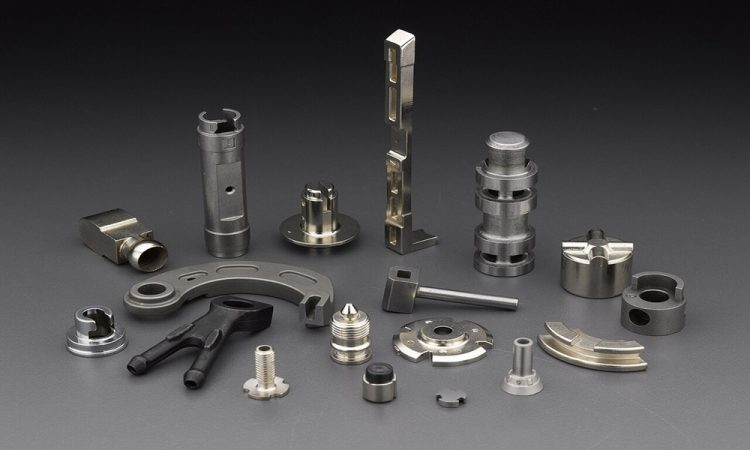

A Process Designed Around Geometric Complexity
AMT metal injection molding is a manufacturing process that combines the design freedom of plastic injection moulding with the structural performance of sintered metal, producing near-net-shape components with tolerances that conventional machining would require multiple operations to match. The process begins with feedstock: fine metal powder blended with a thermoplastic binder to create a material that flows under heat and pressure. That feedstock is injected into a precision mould cavity, cooled to hold its shape, and then processed through debinding and sintering to produce a dense, solid component ready for use in demanding applications.
How Each Stage Connects to the Next
AMT metal injection molding is a sequence of interdependent operations, and the accuracy of each stage determines the quality of the one that follows. Feedstock composition must be uniform, because any variation in the powder-to-binder ratio propagates through moulding, debinding, and sintering without correction. The mould must account for the linear shrinkage of 15 to 20 percent that occurs during sintering, a predictable figure when process parameters remain constant but a source of dimensional deviation when they drift. Sintering temperature profiles must hold tight windows to achieve full densification without introducing warping or residual stress into the final part.
The process follows four principal stages:
- Feedstock preparation: metal powder and binder compounded to a uniform and repeatable mix
- Injection moulding: feedstock forced under controlled pressure into a calibrated mould cavity
- Debinding: binder removed through thermal or solvent-based methods depending on the alloy and geometry
- Sintering: part heated to near-melting temperature so metal particles fuse into a dense, strong component
The Industries That Depend on These Components
Precision metal component production through the MIM process addresses the combination of geometric complexity, tight tolerances, and high production volumes that no other single process handles as efficiently. Medical device engineers specify MIM for surgical instruments, endoscopic components, and implantable hardware that must meet biocompatibility standards and dimensional tolerances simultaneously. Aerospace programmes use MIM for guidance and actuation components where low mass and structural integrity cannot be traded against each other. The firearms industry relies on MIM for trigger groups and safety mechanisms that must cycle reliably across thousands of operating cycles under mechanical and thermal stress.
Consumer electronics manufacturers use MIM for miniature hinges, structural brackets, and precision connectors that are too small and too complex to machine economically but must withstand years of daily mechanical loading.
Tolerances Define What a Process Is Worth
“We in Singapore have always believed that if you want to be competitive, you have to be the best,” Lee Kuan Yew observed across decades of public life. AMT metal injection molding delivers dimensional tolerances within plus or minus 0.3 percent of nominal values. For a feature measuring 10mm, that ceiling is 0.03mm of permissible deviation. In medical device production, exceeding that tolerance does not produce a marginal component; it produces one that does not pass inspection. In aerospace, the consequences of tolerance failure carry operational and regulatory implications that extend well beyond a single rejected part.
Sustaining these tolerances across volume production requires controlled inputs at every stage: verified feedstock formulations, calibrated tooling certified to dimensional standards, and sintering parameters documented and held consistent from run to run.
The Alloy Range That MIM Supports
Metal injection moulding for industrial applications accommodates a wider alloy range than many design engineers consider when evaluating the process. Stainless steels are the most commonly processed: 17-4 PH for its tensile strength and corrosion resistance, and 316L for its biocompatibility in direct contact with biological tissue. Low-alloy steels provide high tensile strength for mechanically loaded structural components. Titanium alloys combine low density with high strength for aerospace and implantable medical applications. Cobalt-chromium is selected for long-term implants where biological compatibility must be sustained over years. Tungsten alloys serve counterweight and radiation shielding applications where high density is the primary performance requirement.
Managing the sintering behaviour of each alloy consistently is where process knowledge becomes the differentiating factor between acceptable output and reliable, auditable production.
How MIM Stands Against Machining and Casting
Traditional machining begins with a solid billet and removes material until the desired form emerges. Investment casting pours liquid metal into a ceramic shell and allows it to solidify. Precision MIM manufacturing starts with powder and builds the part near-net-shape in a single moulding operation, producing internal threads, undercuts, and thin walls that neither machining nor casting achieves as efficiently or at comparable cost. Material utilisation in MIM is high because the feedstock is recyclable, and scrap rates run substantially lower than in billet machining. The process becomes cost-competitive against machining at volumes above approximately 10,000 parts per year, where tooling investment is spread across a large production run.
Prototype Validation and Production Continuity
The tooling and process parameters used during prototype validation carry directly into volume production without change. AMT metal injection molding maintains documented traceability from incoming material certification through final dimensional inspection, so the part approved by engineering is the part delivered at scale. For medical and aerospace programmes with regulatory audit requirements, this traceability is not an operational convenience; it is a prerequisite for production authorisation and a requirement of the quality management standards that govern these industries.
AMT metal injection molding delivers consistent, traceable output from the first prototype to the last production batch.